
Smart home automation in Emirates Hills villas operates at a scale and integration depth rarely seen outside dedicated commercial buildings, with multi-thousand-circuit Lutron HomeWorks QSX systems and Crestron 4-Series control processors managing lighting, climate, audio-visual, security, and shading across 18,000 to 35,000 square foot residences. Villa renovation in dubai projects in Emirates Hills typically allocate 4% to 8% of total project budget to smart-home integration, reflecting the scale and depth of the work. This article documents the systems, the integrators, and the specification logic that produces durable installations.
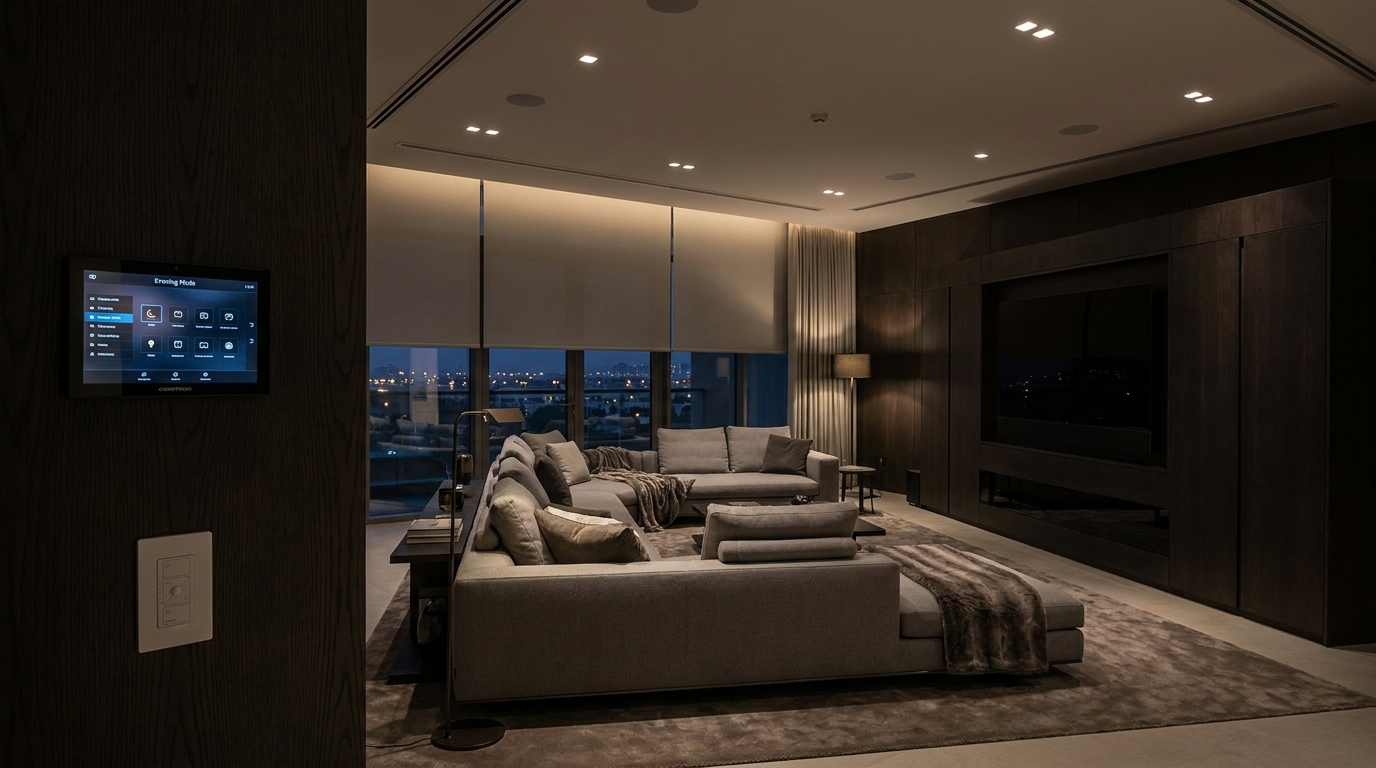
The control systems used in Emirates Hills
Three smart-home control protocols dominate Emirates Hills villa specifications:
Crestron (USA, founded 1971): Proprietary closed system. Highest customization depth, programmed in Crestron’s SIMPL/SIMPL+ language. Used in Emirates Hills villas with extensive AV integration, multi-zone audio, cinema rooms, and clients valuing premium touch interfaces. The Crestron 4-Series control processors handle a 25,000 sq ft villa with multi-room AV and full lighting control.
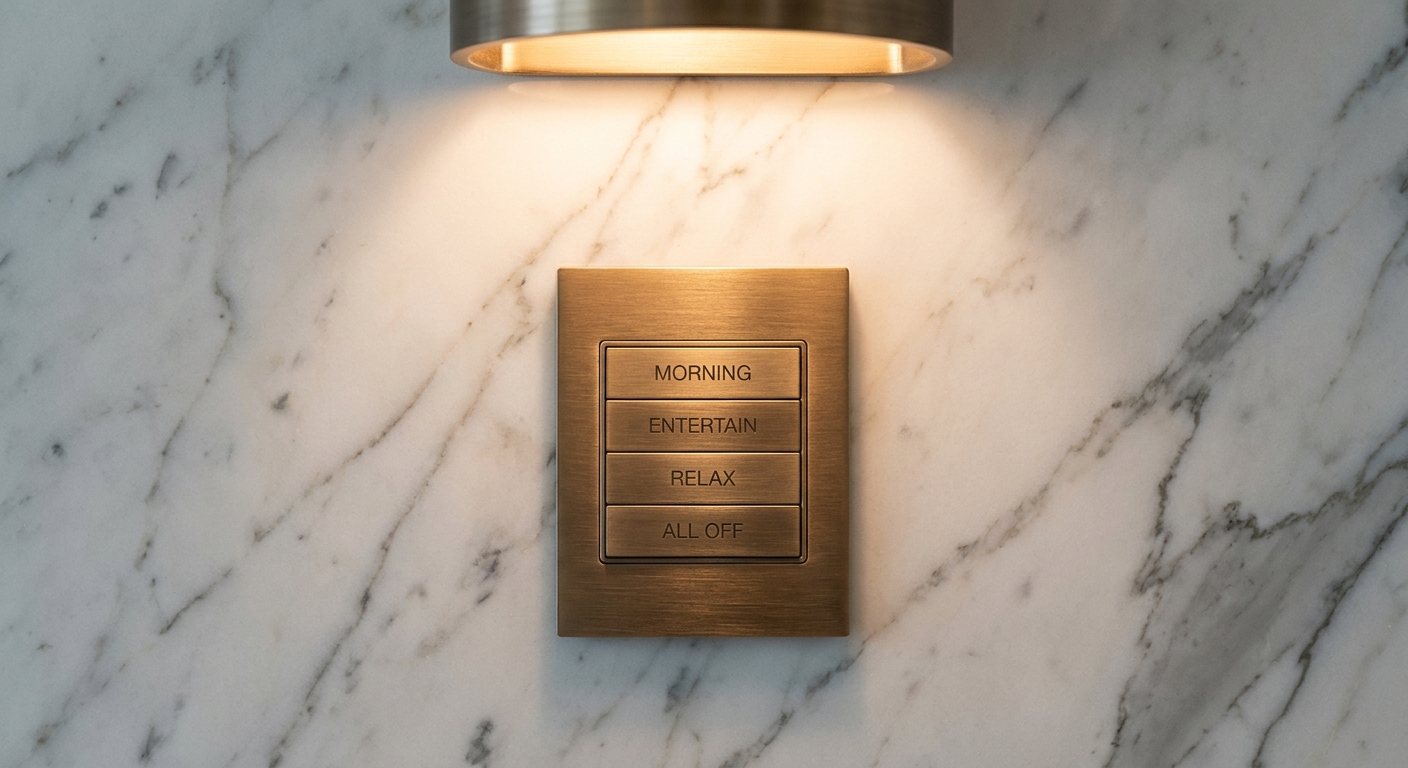
Lutron HomeWorks QSX (USA, founded 1961): Wired lighting and shading specialist. Industry-leading dimming engineering across LED, halogen, fluorescent, and incandescent loads. Standard specification for Emirates Hills villas with extensive decorative and architectural lighting programmes. Palladiom keypads with engraved engraving labels are the Lutron interface signature.
KNX (open standard, founded 1990): European open-protocol system. Devices from ABB, Gira, Siemens, JUNG, Berker interoperate at protocol level. Used in Emirates Hills villas favoring open-standard flexibility, multi-vendor hardware selection, and the option to switch integrators without re-programming. Strong fit for owners with European design backgrounds.
Hybrid system designs
Most Emirates Hills villas specify hybrid systems rather than single-protocol installations. A typical hybrid combines Lutron HomeWorks QSX for lighting and motorized shading (the dimming reliability and engineering quality justifies the dedicated specialist), Crestron 4-Series for AV control and automation logic, and KNX for HVAC integration and BMS-style functions. The hybrid arrangement requires careful coordination at the integrator level (typically Sevenedge, AudioVisor, or Smart Solutions Dubai) but produces system reliability superior to single-protocol solutions for villas of this scale.
Lighting circuit count and engineering
Standard Emirates Hills villa lighting specifications run 200 to 600 individually-controlled circuits. Each circuit may dim multiple fixtures (a single circuit can drive 8 to 12 dimmable LED fixtures of compatible specification). Premium specifications expand to 800 to 1,400 circuits where individual room scenes require granular control.
Dimming compatibility: LED loads require dimmer-fixture compatibility verification at specification stage. Lutron HomeWorks QSX dimmers with Hi-Lume LED drivers handle current-generation premium LED fixtures (Flos IC Lights, Artemide architectural, Vibia Wireflow) without flicker. Standard residential dimmers cause LED flicker at low output, visible particularly in cinema and bedroom scenes.
Motorized shading and curtain integration
Emirates Hills villas typically include 40 to 120 motorized window treatments. Lutron HomeWorks QSX, Somfy, and Lutron Sivoia QS Shading systems are the primary specifications. Premium installations use roller shades (with Mecho or Coulisse fabric) for solar-control function, paired with decorative motorized drapes (with Loro Piana, Pierre Frey, or Dedar fabrics) for evening light control. The two-layer specification is standard for living rooms, bedrooms, and dining rooms.
Climate control integration
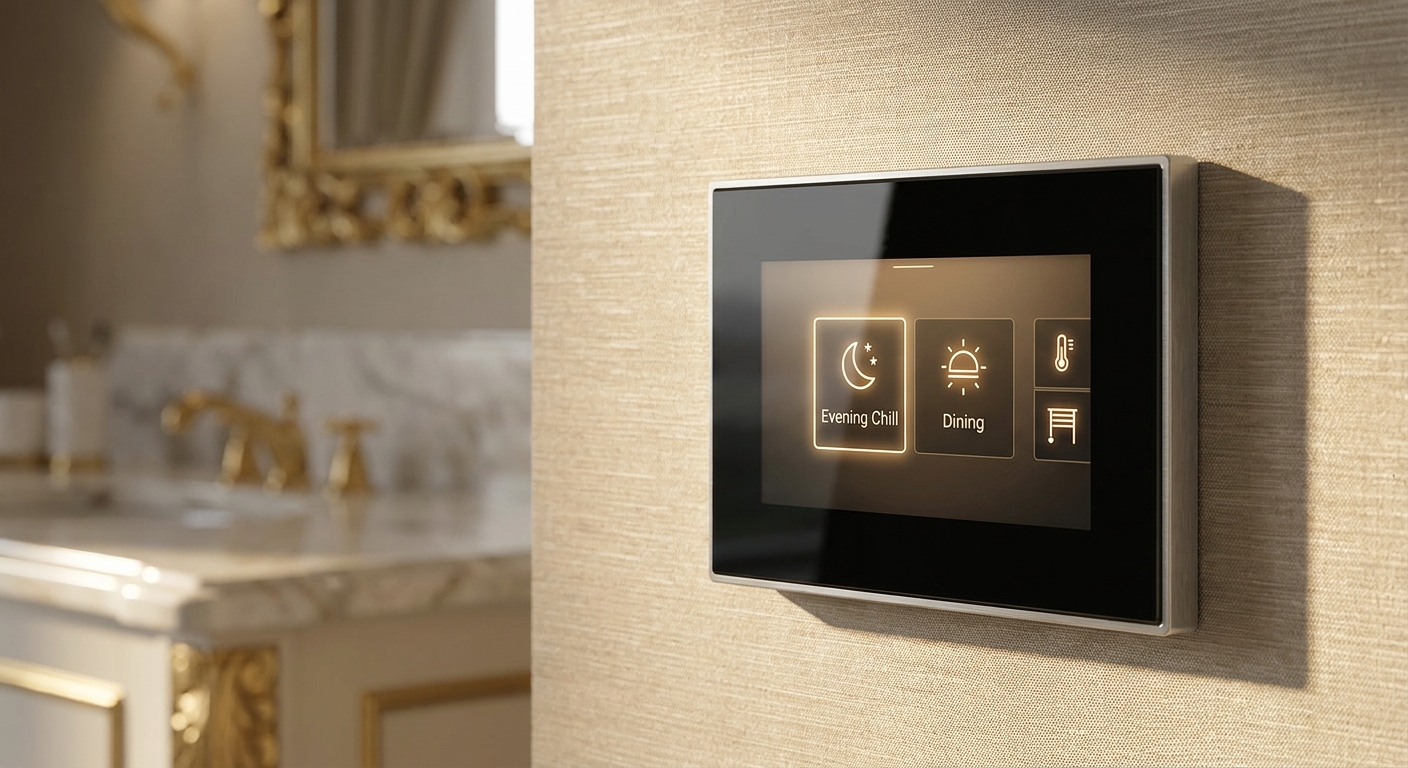
Standard Emirates Hills villa HVAC: 8 to 18 separate zones, each with individual thermostat control. Modern specifications use KNX-integrated thermostats from Theben, Gira, or JUNG, communicating with Daikin, Mitsubishi, or York chiller plant infrastructure. Setback schedules and presence-based zone control (using motion sensors integrated with the lighting system) reduce energy consumption by 25% to 40% versus uniform 22°C settings.
Audio-visual specifications
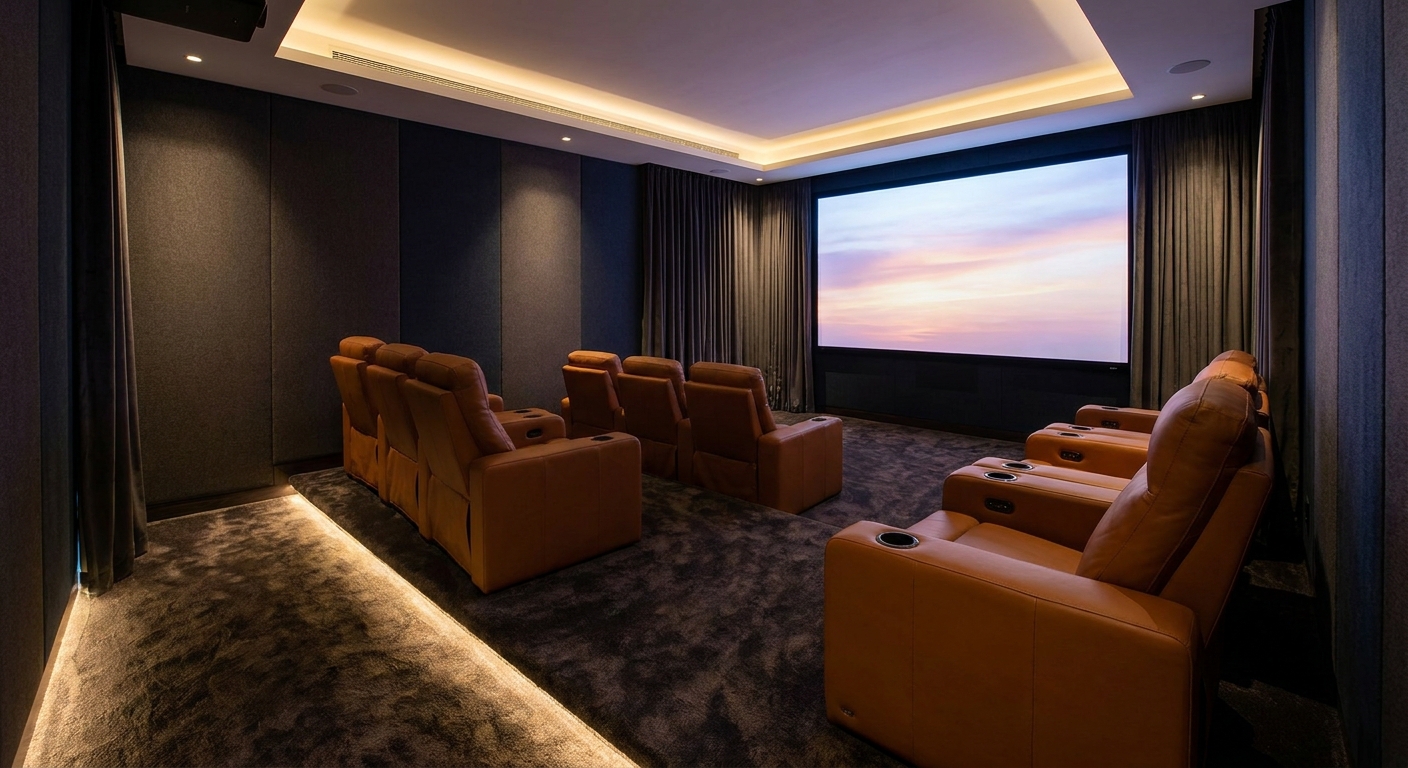
Emirates Hills villa AV typically covers 12 to 25 zones (living, family, master, guest suites, dining, kitchen, terraces). Whole-house audio runs through Sonos (entry-level), Crestron Sonnex (mid-tier), or fully distributed amplification (Trinnov, Storm Audio for cinema-grade rooms with multi-channel speakers). TVs are typically 75 to 98-inch OLED in family rooms and 130 to 220-inch projection or direct-view LED in dedicated cinema rooms.
Security and access control
Emirates Hills villa security specifications include perimeter intrusion detection (typically Honeywell or Bosch systems with the community master station), 16 to 40 IP CCTV cameras (Axis, Hanwha, or Avigilon brand premium), facial-recognition access control (integrated with Crestron or KNX scenes), and panic-button infrastructure connected to Emirates Hills Owners Association response. Security system selection requires Dubai Police approval for the specific brand and configuration.
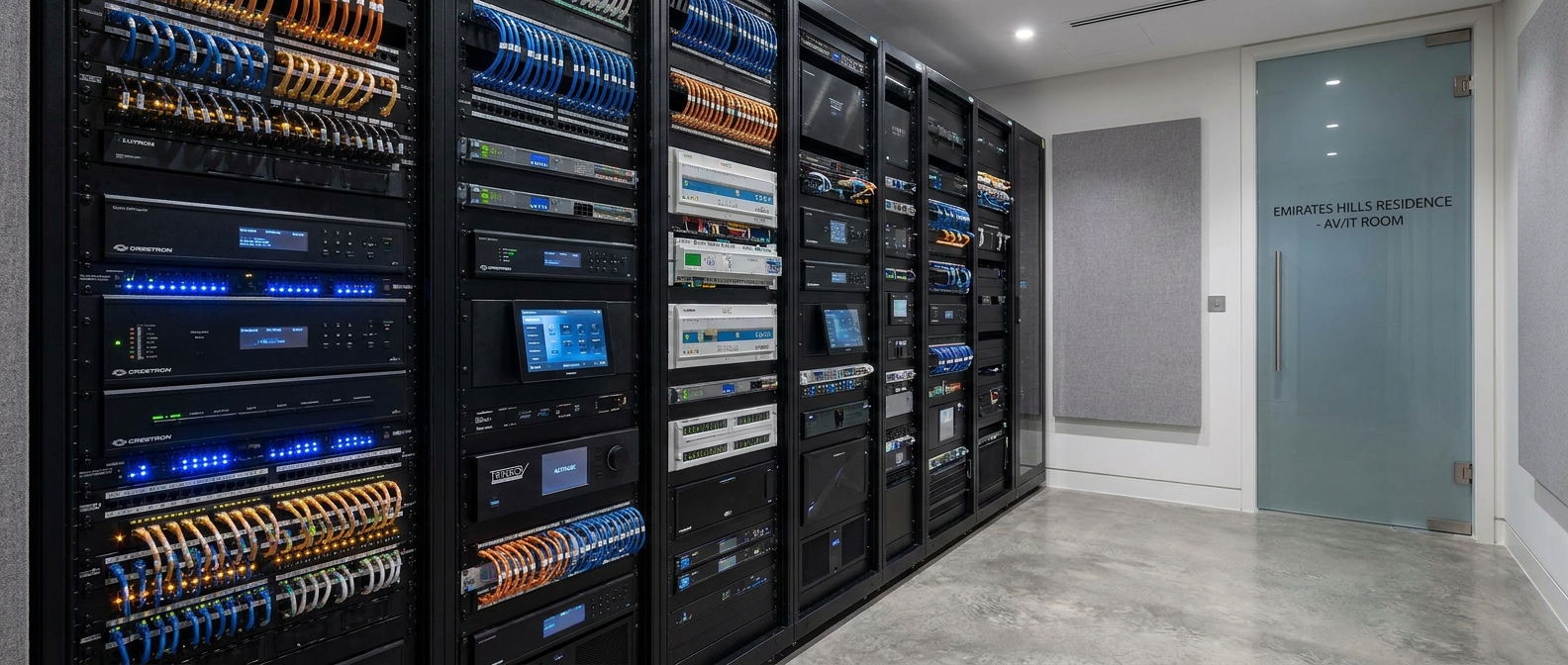
For villas that keep camera footage or media locally, the rack schedule should identify the storage device rather than say only “server.” The SSD finder at RawSpecs can filter by capacity, interface, cache and endurance, giving the integrator a documented starting point for any SSD used as an OS or cache volume.
Real installation timelines
Smart-home installation timelines run parallel with construction:
- Conduit and back-box installation: integrated with first-fix electrical (weeks 8 to 14 of construction)
- Cable pulling: weeks 14 to 20
- Hardware installation (keypads, touchpanels, shade motors): weeks 28 to 32
- Programming and commissioning: weeks 32 to 40
- Final calibration and client training: weeks 38 to 44
Late-stage smart-home addition (after first-fix electrical) is significantly more expensive and produces visible compromises in cable runs, conduit overflow, and panel sizing.
The integrators serving Emirates Hills
Premium smart-home integrators with Emirates Hills villa portfolios include Sevenedge, AudioVisor, Smart Solutions Dubai, and BlueScreen Technical Solutions. All four hold Crestron, Lutron, and KNX certifications. Selecting an integrator with all three certifications matters because hybrid systems are now the norm rather than the exception, and integrator-level expertise across protocols determines system reliability.